Plasma (Ion) Nitriding
Plasma nitriding is a thermochemical surface hardening process which is apllied ferrous materials.
Plasma Nitriding process which is performed in special
designed vacuum furnaces, is achieved by directing the ionized process
gases by electric current to the workpieces.
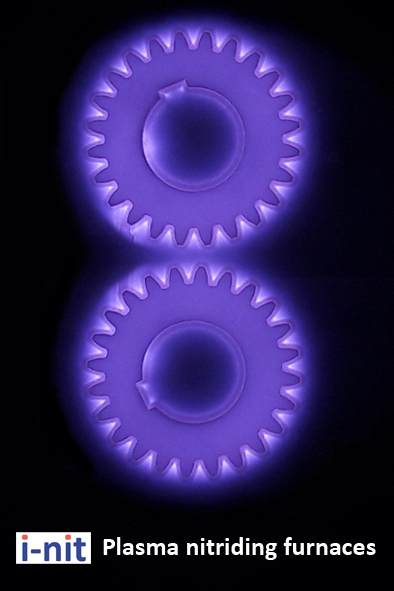
When the workpieces are reached to diffusion temperature by slow heating up, by means of the plasma phase surrounding the workpieces uniformly, nitrogen atoms start to diffuse into from the surface. Plasma nitriding hardens the surface of materials by enriching them with nitrogen from the surface upwards, and forming nitride compounds with the base material and alloy elements.
Plasma nitriding, primarily used to increase surface hardness and wear resistance in steel and cast iron materials, differs from other heat treatment methods because it does not cause a phase change (it occurs in the ferritic phase).
Having the lowest processing temperature among nitriding methods is one of the most important features of plasma nitriding.
The plasma nitriding process temperature can be between 300-580 ° C, depending on the type of material, the heat treatments previously applied, and the desired surface properties.
The plasma nitriding process time can be adjusted from 15 minutes to 120 hours (or even longer if necessary), again depending on the desired surface properties.
The gases used in plasma nitriding (N2, H2, CH4, Ar, N2O, CO2) can vary widely depending on the desired surface properties, and these gases can be used in the desired ratios. This allows for easy influence on the characteristics of the nitriding layer obtained on the material surface.
Plasma nitriding does not use gases that pose risks to the environment or worker health. It does not produce hazardous waste gases. This is one of the significant advantages plasma nitriding offers to businesses.
Properties of Plasma Nitriding
Applicable Areas